

Delay and disruption are two of the most frequently discussed issues in construction claims. They are often spoken about together and, in practice, regularly arise from the same events. Despite this, they are not the same thing. They affect projects in different ways, require different methods of analysis, and can lead to very different contractual remedies.
Understanding the distinction is particularly important when administering or pursuing claims under FIDIC contracts. Confusing delay with disruption can result in poorly presented claims, insufficient evidence and, ultimately, a failure to recover entitlement. For employers, contractors and consultants alike, recognising the difference is the first step towards effective contract administration and dispute avoidance.
Understanding the Difference
At its simplest, delay concerns time, whereas disruption concerns productivity.
A delay occurs when progress is affected to the extent that completion of a particular activity takes longer than planned. This may or may not impact the completion date of a project. Depending on the circumstances, a delay may entitle the contractor to an extension of time, additional payment or both.
Disruption is different. Work continues, but not in the manner originally anticipated. Labour, plant or resources become less efficient because normal working methods have been disturbed. A project may therefore remain on programme whilst the contractor incurs significant additional costs because of reduced productivity.
The Society of Construction Law Delay and Disruption Protocol makes this distinction clear. It defines disruption as a disturbance, hindrance or interruption to normal working methods resulting in reduced efficiency. The Protocol also emphasises that disruption does not necessarily result in delayed completion, just as delay does not automatically mean productivity has been lost. These are separate issues which should be analysed independently.
Although the distinction appears straightforward, it is frequently misunderstood during live projects. Claims are often described simply as claims for “delay and disruption” without identifying which losses arise from delayed completion and which arise from reduced productivity. This creates unnecessary complexity because each requires different evidence and different methods of assessment.
Understanding Disruption
Disruption presents a different challenge. Unlike delay, disruption focuses on how efficiently work was carried out rather than when it finished. Productivity losses are often less visible than delay because work continues to progress, albeit at a slower or less efficient rate.
A contractor may have planned to complete an activity using a particular number of operatives over a defined period. If constant design changes or repeated resequencing mean that the same activity requires significantly greater labour input. Disruption may have occurred even if completion dates remain unchanged.
This distinction is particularly important on projects where contractors accelerate works or recover lost time. Completion may ultimately be achieved by the contractual completion date, yet the contractor may have incurred substantial additional labour, plant and supervision costs in doing so. For this reason, disruption claims are often more difficult to identify during the course of a project. Productivity losses tend to develop gradually rather than resulting from a single identifiable event.
Common Causes of Disruption
Construction projects rarely proceed exactly as planned. Numerous events can interrupt normal working methods and reduce efficiency. Some examples include:
- Poor coordination between trades can lead to congestion within work areas, preventing activities from taking place in the intended sequence.
- Design revisions may require completed work to be revisited or reconstructed, resulting in rework and wasted labour. Restricted site access can force contractors to adopt alternative methods of working that were never anticipated.
- Material shortages, delayed approvals, excessive overtime, acceleration measures and changing priorities can all contribute to reduced productivity.
In many cases, disruption arises not because of one significant event but because of the cumulative effect of numerous smaller events occurring throughout the project.
Whilst each issue may appear relatively minor in isolation, together they can have a significant impact on efficiency and project costs.
Proving a Disruption Claim
One of the reasons disruption claims are often unsuccessful is the evidential burden. Demonstrating disruption requires more than merely identifying events that occurred during the project. The contractor must establish three fundamental elements as identified in the case of Walter Lilly v Mackay.
- First, there must be contractual entitlement arising from the relevant event.
- Secondly, it must be shown that the event actually caused disruption to productivity rather than simply occurring during the same period.
- Finally, the contractor must demonstrate the financial consequences flowing from that reduced productivity.
Establishing this chain of causation for disruption is often considerably more difficult than proving delay. Productivity can be influenced by numerous factors. Contractors must therefore separate compensable (client created) disruption from inefficiencies arising from their own management or operational decisions.
Contemporaneous records become particularly important. Daily site diaries, labour allocation sheets, plant records, progress photographs, meeting minutes and correspondence, can all assist in demonstrating how working methods changed over time. Without detailed records, proving causation becomes increasingly challenging.
Quantifying Disruption
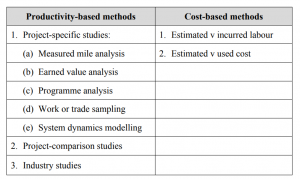
Unlike delay claims, which generally rely upon programme analysis, disruption claims require assessment of lost productivity. The Society of Construction Law recognises the Measured Mile approach as the preferred methodology where suitable project data is available. It is a technique used to identify and quantify productivity loss on construction projects. It involves measuring the productivity of a particular task or activity over a set distance, referred to as the “measured mile.”
The Measured Mile is generally regarded as one of the most reliable approaches because it relies upon actual project performance rather than theoretical assumptions.
However, it is not always possible to identify an appropriate comparison period. Where disruption has affected the project throughout its duration, or where adequate records have not been maintained, alternative analytical methods may be required. Regardless of the methodology adopted, any assessment must remain firmly supported by contemporaneous evidence.
Simply demonstrating that project costs exceeded the original budget will rarely be sufficient. Tribunals expect clear evidence linking specific disruption events to measurable productivity losses.
Delay Under FIDIC Contracts
FIDIC contracts contain detailed mechanisms for dealing with delay. The contract establishes the circumstances in which a contractor may become entitled to an extension of time and, where appropriate, additional payment. Not every delay gives rise to entitlement. The contractor must demonstrate that the delaying event falls within the contractual provisions and that it has affected the critical path of the project. Delay affecting non-critical activities may not impact completion and therefore may not justify an extension of time.
Successful delay claims typically rely heavily upon programming evidence. Baseline programmes, updated programmes, progress reports and contemporaneous records all play an important role in demonstrating how an event affected progress.
FIDIC also places significant importance on contractual notices. Contractors are expected to notify claims within the timeframes required by the contract. Failure to comply with notice provisions can have serious consequences for entitlement, regardless of whether the underlying delay actually occurred.
Considerations Under FIDIC
Good project administration remains one of the most effective ways of protecting entitlement under FIDIC contracts. Parties should avoid treating delay and disruption as interchangeable concepts. Whilst they often arise from the same underlying events, each requires separate consideration.
Where delay affects completion, programme analysis will generally become the primary focus. Where productivity has reduced without necessarily delaying completion, disruption analysis may be required instead. Understanding which claim is being advanced, and why, significantly improves the quality of submissions and reduces the likelihood of disputes becoming unnecessarily complicated.
Conclusion
Delay and disruption remain closely connected but fundamentally different aspects of construction claims. Delay concerns the impact of events upon time, whereas disruption concerns the impact upon productivity. Under FIDIC contracts, both may be recoverable where contractual entitlement exists, but each demands different evidence, different methods of assessment and different approaches to quantification.
Maintaining detailed records, complying with contractual procedures and understanding the distinction between delay and disruption remain essential. Projects will inevitably encounter unforeseen events. The difference between a successful claim and an unsuccessful one often lies not in what happened on site, but in how those events were recorded, analysed and ultimately presented. Avoiding formal and costly disputes can be achieved with good records and careful analysis.
For more help or support with any of the issues outlined in this article, get in touch with the team today.